Posts

Amazing Asexuality

Image
One of my most popular posts on this blog has been, "Giving Birth to Hairy Worms", all about the Renaissance belief in spontaneous generation (ie giving birth without the need for sexual reproduction).  While the idea may seem far fetched, it turns out that spontaneous generation is in fact all around us.  And it's called parthenogenesis. In fact, it's right in my garden.  The round things growing on my tree are oak galls.  They are created by wingless, asexual female gall wasps, which are born from galls in the tree roots, created by winged females, who have mated with males.  The tree galls hatch more wasps, which begin the double cycle again.  So every other generation of female gall wasps will be asexual and wingless.  The next generation will be sexual and winged. Other creatures that reproduce asexually incude aphids, which produce exact clones of themselves, and a certain species of ant. Amazingly, parthenogenesis is not limited to small creatur...

Where are the shy heroines?

Image
Last night, my daughter and I watched Frozen for the first time.  (Yes, I know, we took a while getting around to it).  I don't intend to write a review of Frozen here (basically, I didn't think it was as good as Tangled ).  But I do mean to say that I found the heroines a bit annoying.  They were too loud for me, too independent, too feisty. I've never liked feisty heroines.  Right from reading Little Women as a child.  I know so many people wanted to be Jo, but I wished Beth could have been the writer (as well as a pianist).  Then she would have been like me, right down to the name.  Growing up, I identified with Marty South (Thomas Hardy's The Woodlanders) , following Giles about, too afraid to admit she loved him, Fanny Price (Jane Austen's Mansfield Park ), bossed about by everyone in the house with only Edmund treating her like a human being) and especially the Lady of Shalott, trapped in her tower, unable to cross the room.  (Yes, we'r...

Silver Hands - Your Questions Answered

Image
Yesterday, I did an author event at Blackwell's Universty Bookshop, Leeds, talking about my historical fantasy novel, Silver Hands.  Seeing as only people who were available at 2pm in  Leeds could be there on the day, I thought I would post the answers to one or two Frequently Asked Questions about Silver Hands and writing in general. Q: How long did it take you to write Silver Hands? A: I got the first ideas for the story after reading The Handless Maiden in Grimm's Fairy Tales in 2007.  I started actually writing down the story in June 2009.  I finished editing and started submitting in 2011, and the book was published in 2013. Q: How do you discipline yourself/Do you have a writing routine? A: I always find this question hard to answer, as I think my feelings about writing are more devotion than discipline.  I would rather be writing than doing anything else, but sometimes it is hard to get motivated because of anxiety/depression.  The best advice I ever...

The Real Twitter #2

Image
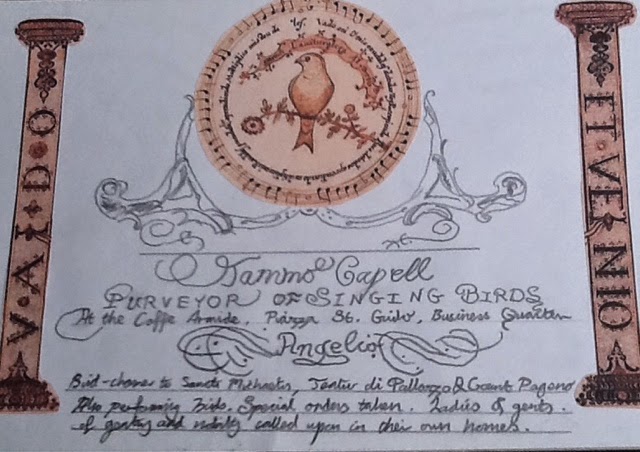
Following on from my last blog about bird lore, I came across a piece of artwork on Twitter (ironic!) that seemed to conjure up the spirit of Tammo ( the bird charmer character in my work-in-progress the Angelio Trilogy ) perfectly.  It is by talented British artist, Rachel Toll (@Elidanza) , who has kindly agreed to let me share it with you here. My character, Tammo, is given the ability to charm birds with his flute.  This can also cause him to form a close bond with the bird in question, as happens with his pet crow, Coronis.  If you think this idea sounds a lot like Mozart's The Magic Flute , you're right.  And that's why Tammo's sworn twin, Carlo, always calls him Tamino. This piece of artwork seemed a perfect gift for Tammo.  (Perhaps I could give it as an Easter present to him!)  And since Tammo plays the flute, I had to try the tune on my flute too.  Because not all the notes were visible on Twitter, I improvised the bits I couldn't see,...

The Real Twitter

Image
Spring has come to Britain at last!  It is April, when: smale fowles maken melodye, according to the poet Chaucer.  It's a time when birds fight for their territories, find their mates, build their nests and lay their eggs.  Outside my house, the favourite visitors are starlings, magpies, crows, pigeons and blue tits.  I'm sure we will see new young ones in the course of time. While working on my Angelio books, I have turned up a lot of interesting research regarding birds.  I thought I would share some of it with you here.  Here are 10 interesting facts: 1.  A common trick for a pet goldfinch was to draw up a tiny gold bucket on a chain to get its drink of water. 2.  "Whistling bullfinches" could be taught to sing a selection of folk tunes. 3.  Castrati were taught to imitate birdsong in their vocal performances. 4.  In Sufism, the language of the birds is a mystical language of angels.  (See The Conference of the Birds by 12th cen...

The Castrato Poet

Image
As I work on my current project, the Angelio Trilogy - about the friendship of castrato Carlo and bird-charmer Tammo in the fictitious city of Angelio - all sorts of interesting things come up in research.  This week, I've been writing a poem for use in book 2, and have turned for inspiration to the castrato poet, Filippo Balatri da Pisa (1676-1756).   As far as I know, Filippo is the only castrato who wrote about his feelings and experiences publicly.  He wrote a memoir in verse called Frutti del Mondo (The Fruit of the World) which tells of his travels as a singer, and some of his feelings about himself.  It is probably one of the best insights we have into how a castrato singer saw himself, his life and his fate. Here are some examples (in translation):- "I am young, Italian and castrated and seek my glory only through singing." "I was already made into a mixed gender, That is a soprano, and was quite young. I apply myself to singing in the most human style Doing ...

Love Divine

Image
I was recently watching a programme on the BBC called Rococo: Travel, Pleasure, Madness.   In the second episode (Pleasure) the presenter,  Waldemar Januszczak, drew our attention to the painting, "Pilgrimage on the Isle of Cythera" (1717) by  Jean-Antoine Watteau.   In classical mythology, Cythera was the birthplace of Venus.  Cronos the Titan castrated his father Uranus and threw his testicles into the sea.  The sperm from them gave birth to Aphrodite/Venus, the goddess of love.  She rose, fully formed from the waves and floated to the Mediterranean island of Cythera (Kythira).  In legend, this island was the only place where perfect love could be found, so the pilgrims in the painting would be very sad to leave. This reminded me of the aria  Fairest Isle, All Isles Excelling from Henry Purcell's semi-opera King Arthur (1691).  It is part of the final, celebratory masque to mark Arthur's victory against the Saxons and his love union wi...